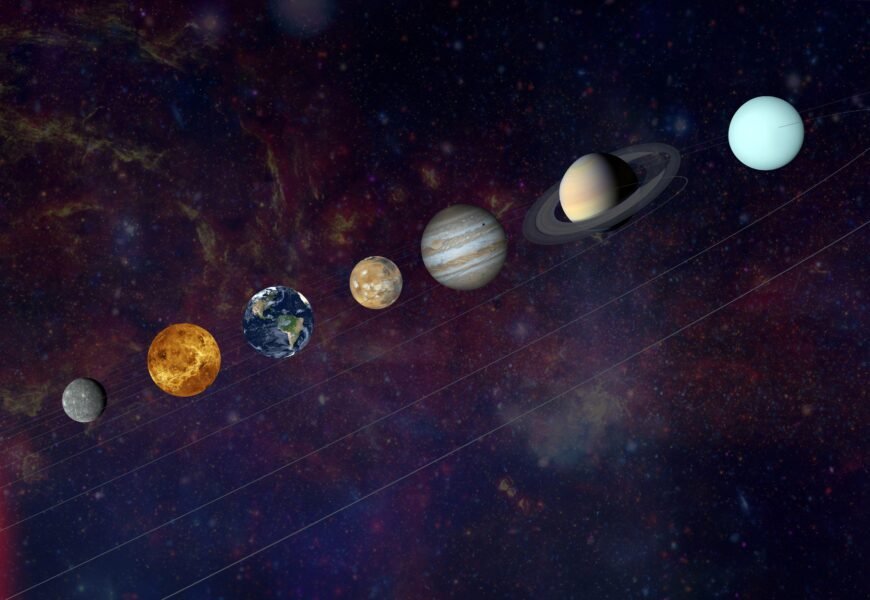
1. What Scientists Mean by a Rare Seven-Planet Alignment
In astronomy, a seven-planet alignment refers to a situation where seven planets appear relatively close together in the sky when viewed from Earth. This does not mean that the planets form a perfect straight line in outer space. Instead, they appear along the same general path, known as the ecliptic, which represents the plane of our solar system.
From a scientific perspective, this alignment is a matter of visual perspective rather than physical rearrangement. Each planet continues to move along its own orbit at its own speed, guided by gravitational forces. The alignment occurs simply because Earth happens to be positioned at a point where multiple planets are visible within a similar region of the sky at the same time.
Astronomers emphasize this distinction to prevent misunderstanding. The planets are not clustering together, nor are they influencing each other in unusual ways. Their distances from one another remain vast, even during an alignment.
What makes a seven-planet alignment noteworthy is not physical interaction, but observational rarity. Coordinating visibility of so many planets requires precise timing and favorable conditions.
Understanding this definition helps readers appreciate the event as a remarkable visual phenomenon grounded in predictable science rather than mystery or speculation.
2. Why Alignments of Seven Planets Do Not Happen Often
Seven-planet alignments are rare because of the complex and independent motion of planets around the Sun. Each planet has a unique orbital period, meaning they complete their journeys around the Sun at very different speeds. Inner planets like Mercury move quickly, while outer planets such as Saturn, Uranus, and Neptune take many years to complete a single orbit.
For all seven planets to appear in the same portion of the sky, their positions must align from Earth’s viewpoint at just the right moment. Even a small shift in timing can change visibility, causing one or more planets to be hidden by sunlight or positioned below the horizon.
Visibility also depends on Earth’s rotation and tilt, which affect when planets rise and set. Some may only be visible briefly during twilight, further narrowing the window for observation.
Astronomers calculate these alignments using precise mathematical models, confirming that such configurations occur infrequently. When they do occur, they are carefully documented and shared with the public.
The rarity of these events adds to their scientific and observational value, making them moments of interest for both professionals and skywatchers.
3. How Planetary Motion Makes Such Alignments Possible
Planetary motion follows predictable paths governed by gravity. Each planet travels around the Sun in an elliptical orbit, maintaining a stable yet constantly changing position relative to Earth. These movements are slow and steady, unfolding over months and years rather than sudden shifts.
Alignments become possible when these independent motions happen to place multiple planets along the same general viewing line from Earth. This alignment is not permanent; it changes gradually as planets continue their orbits.
The science behind this motion is well understood and has been refined through centuries of observation. Modern astronomy uses advanced computing to track planetary positions with exceptional accuracy.
This predictability allows scientists to forecast alignments years or even decades in advance. It also demonstrates the reliability of astronomical models used today.
By understanding planetary motion, readers can see that alignments are natural outcomes of orbital mechanics rather than unexpected or extraordinary disruptions.
4. Which Planets Are Usually Included in a Seven-Planet Alignment
A seven-planet alignment typically includes a mix of inner and outer planets. Brighter planets such as Venus, Jupiter, and Saturn are often the easiest to spot due to their size and reflectivity. Mars may also be visible, depending on its position relative to Earth.
Mercury can be more challenging to observe because it stays close to the Sun and is often visible only during short periods after sunset or before sunrise. Uranus and Neptune are much farther away and usually require binoculars or telescopes for clear observation.
Each planet appears differently in brightness and color, helping observers distinguish them from stars. Astronomers often publish viewing guides to help people identify each planet correctly.
Not all planets will appear equally prominent, but their collective presence within the same region of the sky is what defines the alignment.
Understanding which planets are involved helps observers prepare realistically and enhances the overall viewing experience.
5. Why This Upcoming Alignment Is Attracting Widespread Attention
This rare seven-planet alignment has drawn attention because it combines scientific significance with public accessibility. Many astronomical events require specialized equipment, but this alignment allows several planets to be seen with the naked eye under favorable conditions.
Media coverage and educational outreach have also increased awareness. Space agencies, observatories, and science educators are sharing information to help people understand what they are seeing and why it matters.
Such events often spark curiosity, encouraging people to look up at the night sky and engage with astronomy. For many, it may be their first time consciously identifying planets.
The alignment also serves as a reminder of the orderly nature of the solar system. Despite its vast scale, planetary motion follows consistent and predictable patterns.
By attracting attention without exaggeration, this event provides a meaningful opportunity to connect the public with science in an engaging and responsible way.
6. The Best Time of Day to View a Seven-Planet Alignment
The timing of a seven-planet alignment plays a crucial role in how many planets can actually be observed. Although the alignment itself may span several days, the most favorable viewing window is often limited to early morning just before sunrise or shortly after sunset. This is because many planets remain relatively close to the Sun from Earth’s perspective.
During these twilight hours, the sky is dark enough to reveal planets while the Sun is still below the horizon. Astronomers carefully calculate these windows to guide observers toward the best possible experience. Missing the timing by even an hour can significantly reduce visibility.
The position of the observer on Earth also matters. Latitude, local horizon conditions, and seasonal changes all influence when planets rise and set. What may be visible in one region could be difficult to observe in another.
Because of these variables, official sky charts and astronomy apps are often recommended. These tools provide accurate, location-specific guidance.
Understanding the importance of timing helps observers plan effectively and avoid disappointment during such a rare celestial event.
7. How Light Pollution Can Affect Planetary Alignment Viewing
Light pollution is one of the biggest challenges when observing celestial events. Artificial lighting from cities can overwhelm faint planetary light, making it difficult to distinguish planets from the brightened sky. This is especially true for distant planets that do not shine as brightly.
Urban environments often reduce visibility to only the brightest planets, even during alignments. Streetlights, buildings, and illuminated signage scatter light into the atmosphere, washing out subtle details.
Astronomers recommend observing from darker locations whenever possible. Rural areas, open landscapes, and elevated viewpoints typically offer better conditions. Even small reductions in artificial light can dramatically improve sky clarity.
Turning off unnecessary lights and allowing eyes to adjust to darkness also helps. Human vision becomes more sensitive after spending time in low-light conditions.
By minimizing light pollution, observers can significantly enhance their chances of seeing multiple planets during the alignment.
8. How Astronomers Confirm That an Alignment Is Truly Rare
Astronomers rely on long-term planetary data to determine how rare a particular alignment truly is. By analyzing orbital cycles, scientists can calculate how often similar configurations occur. A seven-planet alignment stands out because it requires several independent cycles to overlap within a narrow timeframe.
Historical records and modern simulations help verify rarity. Some alignments may include fewer planets and occur more frequently, while seven-planet events may only happen once in many years.
Advanced software models simulate planetary motion far into the past and future. These simulations confirm whether a configuration is unusual or part of a recurring pattern.
This careful verification ensures accuracy in public communication. Scientists avoid exaggeration and rely on data rather than speculation.
Knowing that an alignment is genuinely rare adds scientific value and reinforces public trust in astronomical reporting.
9. The Difference Between Visual Alignments and Physical Proximity
One common misconception is that planets move physically closer together during an alignment. In reality, the distances between planets remain largely unchanged. The alignment is purely visual, based on how planets appear from Earth’s viewpoint.
Even during a seven-planet alignment, planets remain separated by millions or even billions of kilometers. Their gravitational relationships do not change in any meaningful way.
This distinction is essential for scientific clarity. Alignments do not increase planetary influence on Earth, nor do they alter orbital paths.
Astronomers emphasize this point to prevent misunderstandings. Visual alignment does not equal physical interaction.
By understanding this difference, readers can appreciate the event without attributing effects that are not supported by science.
10. Why Seven-Planet Alignments Are Valuable for Amateur Astronomers
For amateur astronomers, a seven-planet alignment offers a unique learning opportunity. It allows observers to practice identifying planets, understanding sky movement, and using basic astronomical tools.
Such events encourage hands-on engagement with astronomy. Spotting planets builds confidence and curiosity, often leading to deeper interest in space science.
Alignments also foster community. Astronomy clubs, schools, and observatories often organize group viewing sessions, creating shared educational experiences.
These moments help bridge the gap between professional science and public participation. They show that astronomy is accessible, not exclusive.
By inspiring observation and learning, seven-planet alignments play an important role in expanding scientific awareness.
11. How Planetary Alignments Strengthen Public Interest in Space Science
Rare planetary alignments play an important role in renewing public interest in space science. When people hear about multiple planets appearing together in the sky, curiosity naturally increases. This curiosity often leads individuals to learn more about astronomy, planetary motion, and the structure of our solar system.
Such events serve as reminders that space science is not limited to laboratories or textbooks. It is visible, observable, and accessible to anyone willing to look up at the sky. This accessibility helps remove the perception that astronomy is only for experts or professionals.
Educational institutions frequently use these moments to promote scientific learning. Teachers and science communicators explain the mechanics behind alignments, transforming a visual event into a learning opportunity. This connection between observation and explanation strengthens understanding.
Public enthusiasm also encourages discussions about space exploration, planetary research, and technological advancement. Interest generated by alignments often extends beyond the event itself.
In this way, a seven-planet alignment becomes more than a visual experience—it becomes a gateway to broader scientific awareness.
12. The Role of Astronomy Apps and Digital Tools During Alignments
Modern technology has significantly enhanced how people experience planetary alignments. Astronomy apps, online star charts, and digital sky maps provide real-time guidance for identifying planets. These tools make observation easier and more accurate for beginners.
Such applications use location data to customize viewing instructions. This ensures that users receive precise information about where and when to look. Without these tools, many planets could be easily overlooked or misidentified.
Digital platforms also help prevent misinformation by offering scientifically verified data. This reduces confusion and promotes accurate understanding of celestial events.
Technology bridges the gap between professional astronomy and everyday observers. It empowers individuals to engage with the night sky confidently.
As digital tools continue to evolve, they will likely play an even greater role in public astronomy experiences.
13. Why Planetary Alignments Do Not Affect Life on Earth
Despite widespread myths, planetary alignments do not have measurable effects on life on Earth. The gravitational influence of distant planets is extremely weak compared to everyday forces we experience. Scientific studies consistently confirm this fact.
Even during alignments, planetary distances remain vast. Their combined gravitational pull is insignificant when compared to that of the Moon or the Sun. This reality is well established in physics.
Scientists emphasize this point to counter exaggerated claims. Alignments are visual phenomena, not physical influencers of Earth’s environment or human behavior.
Understanding this helps maintain scientific clarity and prevents unnecessary concern. Observers can enjoy the event without fear or misunderstanding.
Clear communication about these facts is essential for maintaining trust in scientific reporting.
14. How Cultural Interest in the Sky Has Evolved Over Time
Human fascination with the sky is deeply rooted in history. Ancient civilizations observed planets to track time, seasons, and navigation. While interpretations varied, the act of observing celestial movement has always been significant.
Today, scientific understanding has replaced symbolic explanations with evidence-based knowledge. Planetary alignments are now appreciated for their observational value rather than interpreted meanings.
Modern astronomy builds upon centuries of observation, refining accuracy and understanding. This continuity connects past curiosity with present-day science.
Public interest in alignments reflects this enduring relationship between humanity and the cosmos. The difference now lies in interpretation grounded in scientific evidence.
Recognizing this evolution helps place modern observations in historical context.
15. The Importance of Scientific Accuracy in Reporting Astronomical Events
Accurate reporting is essential when communicating astronomical events to the public. Misleading headlines or exaggerated claims can distort understanding and reduce trust. Responsible reporting focuses on facts, clarity, and context.
Scientists and educators emphasize precise language to avoid confusion. Alignments should be described accurately as visual configurations rather than dramatic occurrences.
Reliable information allows readers to appreciate events without misconceptions. It also supports informed discussion and learning.
Media outlets that prioritize accuracy contribute positively to public scientific literacy. This responsibility becomes especially important during widely publicized events.
Clear communication ensures that interest in astronomy leads to knowledge rather than misunderstanding.
16. How Alignments Encourage Night Sky Observation Habits
Planetary alignments often inspire people to observe the night sky more regularly. After witnessing one event, many individuals develop a lasting interest in astronomy. This habit fosters curiosity and ongoing learning.
Regular sky observation helps people understand celestial patterns, movements, and seasonal changes. Over time, observers become more familiar with constellations and planetary paths.
This engagement strengthens appreciation for natural phenomena and scientific discovery. It also encourages patience and attentiveness—valuable skills in scientific observation.
Alignments serve as entry points into a broader hobby or educational pursuit. They remind people that discovery can begin with simple observation.
Such habits contribute to a deeper connection with science and nature.
17. Why Seven-Planet Alignments Are Best Viewed With Realistic Expectations
Setting realistic expectations is important for enjoying a planetary alignment. The event may appear subtle rather than dramatic, especially to first-time observers. Understanding this prevents disappointment.
Planets will appear as bright points of light, not large or detailed objects. Their significance lies in their collective visibility rather than visual spectacle.
Astronomers emphasize preparation and knowledge over spectacle. Knowing where to look and what to expect enhances satisfaction.
Appreciating the event for what it truly is allows observers to enjoy its scientific value.
Realistic expectations lead to meaningful experiences rather than unmet anticipation.
18. The Educational Value of Explaining Planetary Orbits Through Alignments
Planetary alignments provide excellent teaching moments for explaining orbits and motion. Observing multiple planets together helps illustrate how orbital paths relate to Earth’s position.
Educators often use alignments to explain concepts such as orbital speed, distance, and perspective. These explanations become more engaging when paired with real-world observation.
Visual learning reinforces abstract concepts. Seeing planets aligned makes theoretical models more understandable.
Such educational opportunities help bridge the gap between observation and theory. They strengthen comprehension through experience.
Alignments thus serve as practical tools for science education.
19. How Future Observations Will Continue to Improve Understanding
Future observations of planetary alignments will benefit from advancing technology. Improved imaging, data collection, and simulation tools will enhance accuracy and accessibility.
As technology progresses, more people will be able to observe celestial events with greater clarity. This increased participation supports scientific outreach.
Continued observation also refines astronomical models. Each event contributes data that improves prediction and understanding.
Science advances through observation and refinement, and alignments play a role in this process.
Future generations will benefit from the groundwork laid by current research and public engagement.
20. Why This Rare Alignment Is a Reminder of the Order of the Solar System
A seven-planet alignment highlights the structured nature of our solar system. Despite its vast scale, planetary motion follows predictable laws. This consistency reflects the reliability of physical principles.
Such events remind observers that the universe operates with precision rather than randomness. The alignment is not accidental but the result of well-understood motion.
This realization fosters respect for scientific inquiry and discovery. It reinforces confidence in astronomy as a disciplined field of study.
Observing order in the cosmos encourages reflection and curiosity. It connects observation with understanding.
Ultimately, the alignment symbolizes harmony within cosmic motion.
Strong Conclusion
The rare alignment of seven planets is a remarkable astronomical event rooted in precise science and predictable motion. While visually subtle, its significance lies in its rarity, educational value, and ability to inspire curiosity about the universe.
This event does not bring physical changes to Earth, nor does it represent anything beyond natural planetary movement. Its true value comes from observation, learning, and appreciation of cosmic order.
By approaching the alignment with accurate information and realistic expectations, observers can enjoy a meaningful scientific experience. Such moments remind us that the universe is both accessible and endlessly fascinating.
Planetary alignments invite us not to speculate, but to observe, understand, and appreciate the elegant mechanics that govern our solar system.