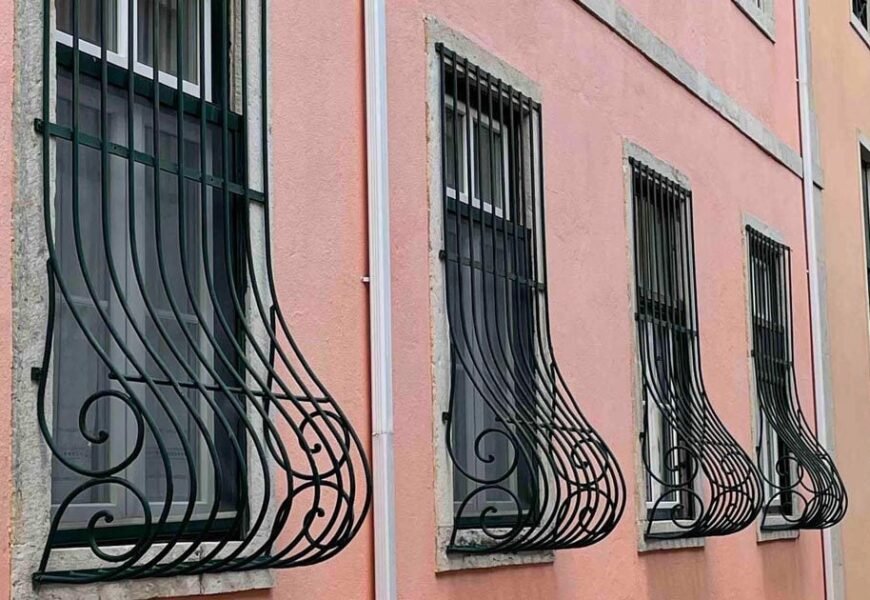
1. A Hidden Blend of Aesthetics and Practicality
When you first notice window grills with curves at the bottom, the design may appear purely decorative. Many people assume homeowners or architects add these curves to bring a bit of flair to an otherwise plain grill. And while it’s true that these curves enhance visual appeal, the deeper reason often goes unnoticed. The curved bottom portion of a grill creates a soft break in the rigidity of straight lines, making the exterior of a building appear more welcoming. From an architectural standpoint, curves naturally draw the eye, softening the overall look of metal and balancing harsh edges.
But this isn’t just about beauty—it’s also about functionality. Curves add additional strength by redistributing pressure more evenly across the structure. A grill designed with a curved base has more resilience when exposed to external forces such as wind, weight, or even accidental impact. Engineers know that curves help reduce weak points in materials, and window grill designers adopt the same principle to prevent sudden breaks or bending.
Interestingly, this aesthetic-practical balance has historical roots. In many cultures, curved elements were associated with prosperity, flow, and protection. For example, old colonial houses often used curved grillwork not only to beautify but also to symbolically “ward off” negative energy while still serving the practical purpose of safety. So, the next time you see a curved grill, remember—it’s more than just a stylish flourish. It represents centuries of design choices where practicality and beauty had to go hand in hand.
2. Extra Space for Airflow and Ventilation
Another surprising reason for curved grills at the bottom is the simple but critical matter of airflow. In many houses, particularly older ones or those located in warmer climates, natural ventilation is essential. Straight grills may restrict air passage or make the opening seem too confined. By adding a gentle outward curve at the bottom, airflow into the room increases significantly.
Think of it as an extension: the curve pushes the grill slightly outward, allowing breezes to flow in at better angles. This design enhances cross-ventilation, reducing the need for mechanical cooling systems during mild weather. In many tropical or semi-tropical regions, homeowners relied on this subtle trick long before air conditioners became common.
There’s also a psychological benefit. A curved grill creates the sense of “roominess” in a window. When you open the window, you don’t feel as boxed in compared to straight, flat grills. That sense of openness indirectly contributes to comfort, particularly for families living in smaller apartments where space already feels limited.
From a functional point of view, good ventilation also contributes to healthier indoor air quality. Fresh air circulation can reduce indoor humidity, prevent mold growth, and make the home feel fresher overall. So, those seemingly decorative curves at the bottom of a window grill may actually play a silent but powerful role in creating a healthier and more comfortable living space.
3. A Safety Feature for Families with Children
One of the most practical and heartwarming reasons behind curved window grills is child safety. For families living in high-rise buildings or homes with multiple stories, windows can pose risks, especially for curious little ones. Straight grills offer protection, but they don’t necessarily give children the space they need to peek outside safely.
Curved grills, however, extend slightly outward, forming a sort of mini-enclosure. This allows children to lean forward and look outside without directly pressing against glass panes or attempting to push past the grill. In fact, in many urban apartments across Asia, parents specifically request curved grills because they act as a buffer zone. They provide both safety and a “viewing spot” for kids without compromising security.
There’s also an emotional angle here. Children love observing the outside world—watching cars, people, or even birds from their windows. Curved grills encourage this natural curiosity in a safe way. Instead of being scolded for leaning too close to a flat grill or risking accidents, children can stand comfortably behind a structure designed with their exploration in mind.
And safety doesn’t just apply to kids. Elderly residents benefit too, as the curve provides a natural resting edge when leaning near the window. By balancing safety with comfort, the curved bottom grill becomes a thoughtful addition to family homes, blending utility with everyday life needs.
4. Allowing Room for Small Indoor Gardens
Another fascinating reason lies in the way curved grills accommodate lifestyle choices. In many homes, especially in cities where outdoor space is limited, residents turn to window grills as mini-balconies for potted plants. The outward curve at the bottom of the grill creates just enough extra room to place small pots or hanging planters.
This design is particularly common in urban settings where residents crave greenery but don’t have the luxury of a garden or large balcony. With curved grills, a homeowner can grow herbs, flowers, or even small vegetables right by the window. The curve supports these small additions without interfering with the opening and closing of windows.
Beyond practicality, this fosters emotional and mental wellness. Studies have shown that having plants nearby reduces stress, improves air quality, and boosts mood. When window grills are curved outward, they create space for a personal “green corner” in the home, even if you’re several floors above the ground.
Moreover, from a cultural perspective, many households view plants at windows as symbolic—representing growth, life, and positivity entering the home. Curved grills unintentionally enable this practice by offering the space that straight grills simply do not provide. So, while you might think of them as purely structural features, in many cases, these curves are enablers of healthier, greener lifestyles.
5. Preventing Direct Contact with Windows
The curved bottom of grills also plays an important protective role for the windows themselves. Flat grills often sit very close to the glass panes, which means that any accidental push, knock, or movement can directly impact the glass, increasing the risk of cracks or breaks. By curving outward, grills create a buffer zone between themselves and the window glass.
This spacing is subtle but significant. It prevents everyday accidents, like children throwing toys, adults carrying objects near windows, or even strong gusts of wind slamming doors shut and shaking frames. In each of these scenarios, the curved grill serves as a protective shield.
Furthermore, this small gap helps with cleaning and maintenance. Homeowners can clean both the glass and the grill more effectively when there’s breathing room between the two. The design, therefore, prolongs the lifespan of the glass panes, reducing replacement costs and ensuring that windows remain functional for years.
Architecturally, this is a clever adaptation. It reduces long-term maintenance costs while subtly improving safety and durability. And while many people never notice this hidden benefit, those who have lived in homes with curved grills often recognize how much easier window upkeep becomes because of this thoughtful design.
6. Extra Security Against Break-ins
Window grills are primarily designed for safety, but curved bottoms add an extra layer of difficulty for intruders. Straight grills are easier to predict and sometimes easier to tamper with, as their rigidity makes them uniform. A curved design, on the other hand, complicates any attempt to break through. The outward bend forces tools like crowbars or cutters into awkward angles, making it more time-consuming for someone to try to compromise the structure.
For burglars, speed is crucial—any delay increases the risk of being caught. This is why even a slight outward bulge in a grill can be a deterrent. Security experts often recommend grills with irregular or curved structures precisely because they disrupt easy access. The curve also allows for thicker reinforcement at the bottom, where pressure is often applied during tampering attempts.
Beyond practicality, there’s also the psychological aspect. Intruders often assess targets quickly. Homes with grills that look more robust and complex—even something as simple as a curve at the bottom—signal difficulty, causing them to move on. So, while many homeowners think of curves as “cute” or “decorative,” they actually contribute significantly to a home’s safety strategy.
7. A Tradition Rooted in Colonial and Cultural Architecture
The history of curved grills dates back centuries, and in many places, it is linked to cultural and colonial influences. In parts of Europe, Latin America, and Asia, ornate ironwork often included curves as a symbol of wealth, beauty, and craftsmanship. Over time, as these design practices spread through colonization and cultural exchanges, they became practical staples in ordinary homes.
Curves were seen as more than just ornamental—they were also thought to represent good fortune and harmony. In Indian and Middle Eastern designs, for example, curves symbolize the natural flow of life, making them spiritually significant as well. When colonial architects introduced metalwork designs into everyday housing, the cultural symbolism remained, blending with practical safety features.
Even today, if you look closely at heritage houses or old apartment complexes, you’ll notice the continuation of these curved forms. They’re not just throwbacks—they reflect how past traditions continue to shape modern architectural practices. So when you ask, “Why are there curves at the bottom of these grills?” part of the answer is simply: because history still whispers through design choices we often take for granted.
8. Creating a Cozy Spot for Pets
Another heartwarming explanation for curved window grills lies in their relationship with pets. In many households, cats and small dogs love perching by the window to watch the world outside. Straight grills restrict their ability to sit comfortably, but curved ones act like miniature balconies, offering a safe and secure perch.
Pet owners often notice how their furry friends naturally gravitate toward windows with curved grills. Cats, for instance, love curling up inside the curve, enjoying sunlight and fresh air without the risk of falling out. Dogs, meanwhile, may use the space to peek outside and observe passersby. In this sense, curved grills cater not only to humans but also to the animals who share our homes.
This design inadvertently strengthens the bond between pets and their environment. It gives them safe access to stimulation and prevents boredom—something veterinarians often encourage for healthy pet behavior. From a design point of view, it’s fascinating how a feature created for structural or cultural reasons can also double as a comfort zone for our four-legged companions.
9. A Psychological Sense of Openness
Flat grills can sometimes feel confining, especially in small apartments or densely packed cities. People looking through them may feel like they’re peering out from behind bars, which can subconsciously create feelings of restriction. Curved grills, however, break this psychological barrier. The outward bend expands the visual space, making the view feel less obstructed.
This subtle change can significantly impact mental well-being. Residents feel less “boxed in” and more connected to the world outside. This is particularly valuable in high-rise apartments where outdoor access is limited. By curving outward, grills create a more inviting connection between the interior and exterior, making the window an extension of the living area instead of a barrier.
Psychologists note that small changes in architecture can influence mood. A window that feels open and inviting encourages positivity, while a restricted view can subconsciously increase stress. So, something as simple as a curve at the bottom of a grill may be contributing silently to a healthier, happier living environment.
10. Helping Rainwater Flow Away
In many regions with heavy rainfall, window grills serve another hidden purpose: guiding water away from the building. When grills are flat and tightly pressed against the wall, rainwater can accumulate at the base of the window, leading to dampness, leakage, or even mold growth. The curved design solves this by pushing the grill outward, allowing rainwater to run off more easily.
The curve prevents water from clinging to the frame and instead encourages it to drip down and away from the structure. Over time, this reduces water damage, preserves wall integrity, and ensures that interiors remain dry. This is especially crucial in tropical climates where monsoons can cause significant water-related issues.
Homeowners may never realize this small detail is working silently for them. Yet, ask any architect or builder in such climates, and they’ll confirm—curved grills are as much about protection from the elements as they are about beauty and safety.
11. Maximizing Natural Light Entry
Curved grills also affect the way natural light enters a room. Flat grills often cast sharp shadows and can block part of the sun’s rays, particularly in the mornings or evenings when sunlight comes at an angle. With curves, however, light is redirected in subtle ways, diffusing more gently into the room.
This effect brightens interiors and reduces the need for artificial lighting during the day. Homeowners benefit from lower energy costs while also enjoying the psychological boost that comes from natural sunlight. Studies repeatedly show that sunlight improves mood, boosts vitamin D production, and even regulates sleep cycles.
So, while most people think of grills in terms of safety or design, their shape plays a surprising role in how well-lit and uplifting a room feels. Curved grills transform the window from a mere opening to a natural light enhancer—an advantage you may not notice consciously but definitely benefit from.
12. Easier to Clean and Maintain
Cleaning windows with flat grills can be frustrating, especially if the grills sit too close to the glass. Dust and grime get trapped in tight spaces, making it nearly impossible to wipe them thoroughly. Curved grills solve this by creating more space between the grill and the glass, allowing easier access for cleaning tools.
This not only improves hygiene but also keeps homes looking brighter and more polished. Dusty grills and smudged glass can make even the cleanest house appear unkempt. By enabling easier maintenance, curved grills quietly ensure that homes retain their visual appeal with less effort.
Additionally, maintenance workers and homeowners alike benefit from this convenience. For high-rise apartments where professional cleaners are often hired, curved grills reduce risks by allowing cleaning from safer angles. In this way, they improve both practicality and safety in everyday upkeep.
13. Symbol of Status and Style
In some cultures, window grills with curves are seen as status symbols. They suggest that the homeowner invested in design beyond the bare minimum, choosing something both stylish and functional. Historically, ornate metalwork was associated with wealth, and echoes of this remain today.
Even in modern apartments, curved grills can set a unit apart, giving it a unique and slightly upscale appearance. Realtors often highlight such design features when marketing properties, emphasizing their beauty and distinctiveness. A small architectural detail like this can subtly increase a property’s perceived value.
In essence, what looks like a simple curve can carry layers of meaning—practical, cultural, and social. It reflects the homeowner’s taste, priorities, and sometimes even aspirations, all wrapped up in a design choice most people overlook at first glance.
14. Reducing Heat Build-up Indoors
Another practical benefit lies in how curved grills influence indoor temperature. Flat grills often sit close to the window, creating a “heat trap” during sunny days as metal absorbs and radiates heat inward. Curved grills, by projecting outward, allow better air circulation and reduce the amount of direct heat transferred indoors.
This small adjustment makes rooms slightly cooler, especially in hot climates. Over time, this reduces reliance on fans and air conditioners, leading to lower energy consumption. It’s a subtle but effective way in which design interacts with climate, making homes more comfortable and sustainable.
So, while few homeowners think of window grills as energy-saving features, their curves may actually be contributing silently to more eco-friendly living.
15. A Space for Decorative Expression
Beyond safety, functionality, and comfort, curved grills offer a canvas for creativity. Homeowners often decorate these curved sections with hanging ornaments, wind chimes, or cultural symbols. The extra space allows for personalization that flat grills don’t provide.
This turns windows into more than just structural necessities—they become expressions of identity and culture. Some families use the curved area for religious symbols, others for seasonal decorations, and some simply for artistic flair. These small touches add character to homes, turning something utilitarian into something warm and personalized.
16. Allowing Emergency Access from Outside
In some designs, curved grills are intentionally made to allow easier external access during emergencies, such as fire rescues. While grills are primarily for keeping intruders out, certain curved models can be designed to swing or detach more easily when accessed from outside.
This feature strikes a balance between safety and emergency preparedness. It ensures that while residents are protected from everyday risks, they’re not trapped in extreme situations. Fire safety experts often encourage window designs that consider both security and emergency exit strategies, and curved grills can accommodate these needs.
17. Reducing Noise Transmission
In noisy urban environments, curved grills also contribute to noise reduction. By altering the angle at which sound waves hit the structure, curves help diffuse noise instead of allowing it to pass directly inside. This effect is subtle but noticeable in homes near busy roads or markets.
Combined with glass windows, the design helps create a quieter indoor atmosphere. For city dwellers, this is invaluable—peace and quiet are luxuries in themselves. The outward curve doesn’t just make the space look better; it also improves the acoustic quality of life indoors.
18. A Safer Option for Drapes and Curtains
Flat grills often sit so close to the window that curtains can get tangled or even damaged. In some cases, they become fire hazards if fabric brushes against candles or incense placed near windows. Curved grills prevent this problem by providing more breathing room, keeping fabric away from sharp metal edges or direct contact.
Homeowners who value both safety and home décor appreciate this feature. It ensures that their choice of curtains remains practical, stylish, and long-lasting, without constant wear and tear from tight spaces.
19. Encouraging Outdoor Connection in Dense Cities
In large cities where balconies are rare, curved grills act as small substitutes. They provide residents with a chance to lean outward slightly, look down at the street, or enjoy a passing breeze. While not a full balcony, they replicate the experience enough to reduce feelings of isolation.
Sociologists note that such small architectural features play a big role in urban mental health. They allow people to feel connected to their neighborhood even when physical space is scarce. A curved grill may be modest, but for someone in a small apartment, it can represent a window into the wider world.
20. An Evolution of Design with Modern Needs
Finally, curved window grills are a reminder of how architecture evolves with human needs. What started as purely decorative centuries ago now serves a range of practical purposes—safety, ventilation, light, comfort, and even emotional well-being. Each curve reflects a compromise between beauty and function, tradition and modernity.
As cities continue to grow and living spaces shrink, these small but meaningful design details matter more than ever. They remind us that architecture is not just about walls and roofs—it’s about the subtle touches that shape how we live, feel, and connect with the world around us.
Conclusion
So, why do some window grills have curves at the bottom? The answer is layered, surprising, and deeply human. They are not just decorative flourishes but carefully evolved solutions addressing safety, comfort, airflow, security, and even cultural symbolism. Curved grills protect children and pets, reduce heat, allow indoor gardens, and connect residents to their surroundings in meaningful ways.
Ultimately, these curves teach us that in design, nothing is accidental. The smallest details often carry the biggest impact. They may look like gentle bends in metal, but in reality, they are quiet guardians of safety, health, culture, and emotional well-being—proof that beauty and purpose can always exist together.