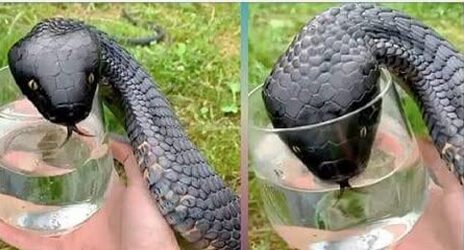
1. The Unexpected Encounter in My Backyard
It was an ordinary summer afternoon, the kind where the sun blazed so fiercely that even the birds had gone quiet. I had stepped outside with a jug of water to pour into a bowl for the stray cats that often visited my yard. That’s when I saw it—curled near the fence, half-hidden in the dry grass, was a snake. At first glance, my body stiffened with fear. Instinct told me to run back inside, but something about the way it moved was different. It wasn’t striking or threatening. Instead, its movements were slow, almost weary, as if it carried the weight of exhaustion. The dry, cracked ground around it mirrored the state of this poor creature, and I couldn’t shake the feeling that it was in distress. Rather than lunging away or coiling aggressively, the snake lifted its head gently, almost as though acknowledging my presence. It was then that I realized—it wasn’t here to attack. It was here because it desperately needed something. My heart pounded, torn between fear and compassion, as I slowly began to understand that the snake might not be a danger but a silent plea for help.
2. The Silent Cry for Water
The air was hot enough to make even humans feel faint, so I could only imagine how a wild animal might suffer without hydration. The snake’s tongue flickered rapidly, not in aggression but more in desperation, as though searching for moisture in the dry air. Its skin looked dull, almost dehydrated, lacking the sheen snakes usually have. That’s when it hit me—maybe this snake wasn’t wandering into my yard by accident. Maybe it was looking for water. I had heard of animals like birds and even deer approaching humans during extreme weather, but a snake? That seemed almost unreal. Yet here it was, dragging itself closer to the bowl I had placed for the cats, stopping every few inches as if each movement was a struggle. My fear slowly melted into sympathy. This wasn’t a predator hunting. This was a creature in distress, asking in the only way it knew how. Its behavior was unusual, but it was unmistakably clear—it needed help. It wasn’t begging with words, but its body language, its weakened state, and its deliberate approach toward the water spoke volumes louder than words ever could.
3. Overcoming Fear to Offer Help
My hands trembled as I poured fresh water into another shallow dish and placed it a safe distance away. The thought of moving too close filled me with unease, but something inside urged me to act. I carefully slid the bowl closer, every nerve in my body on edge, ready to retreat at the first sign of aggression. But the snake did nothing—no hiss, no strike, no coil. Instead, it paused, lifted its head as if considering the offering, and then slowly slithered forward. It dipped its mouth toward the dish, and to my utter amazement, began to drink. The sight was unlike anything I had expected. Snakes don’t often display such vulnerability in the open, yet here it was, openly hydrating in front of me, trusting that I wouldn’t harm it. Watching it drink was surreal, a moment that felt both dangerous and sacred. Fear still pulsed in my veins, but it was now mixed with awe. The wild snake, a creature I had always associated with danger, had come to me in its time of need, and I had somehow found the courage to help.
4. The Neighbors’ Shocked Reactions
Word travels fast in small neighborhoods, especially when it involves something unusual. My next-door neighbor, who had been watering his plants, spotted me standing near the fence, carefully watching a snake drink from a bowl. He froze, eyes wide, and quickly called out, “Are you out of your mind? That’s dangerous!” Within minutes, two more neighbors peeked out, curious and alarmed at the same time. To them, the sight looked unbelievable—someone offering water to a wild snake in broad daylight. Some gasped in horror, others whispered about calling animal control immediately. But I stood my ground, keeping a careful distance but refusing to remove the bowl. Something deep inside told me this was a moment of compassion, not fear. Of course, I understood their panic. Snakes are often misunderstood, and fear of them is deeply rooted in our instincts. But to me, in that moment, it wasn’t a predator. It was a living being struggling to survive the heat. The neighbors might not have seen it yet, but I had—it wasn’t here to harm. It was simply here because it had no other choice.
5. When Animal Control Arrived
Eventually, someone did call animal control. Within the hour, a truck pulled up, and two officers stepped out cautiously with their equipment in hand. They approached slowly, prepared for the worst. The snake was still at the bowl, drinking as though it hadn’t tasted water in days. One officer muttered under his breath, clearly surprised, “Well, I’ll be… this is rare.” The other turned to me, eyebrows raised, and said, “You got lucky. Very lucky.” My heart raced—what did that mean? They explained that snakes rarely show themselves in such vulnerable states, and if this particular one had been even slightly agitated, I could have been in serious danger. But then they added something that sent chills down my spine: “This snake came to you because it had no other option. It was literally begging for water. You helped it, but do you realize how unusual that is? It’s not just lucky—it’s extraordinary.” Their words lingered in my mind, filling me with both relief and awe. What I had seen wasn’t just rare. It was a once-in-a-lifetime encounter, one that carried a deeper meaning I would only come to understand later.
6. The Officers’ Explanation That Changed Everything
As the snake continued drinking, the animal control officers began explaining things I had never considered. One of them said, “Snakes don’t usually come this close to humans unless they’re desperate. They avoid us at all costs. The fact that this one slithered toward your water bowl instead of away from you means it recognized you as its last chance.” Their words made me realize the gravity of what had just unfolded. I thought back to my initial fear—how close I had been to running back inside, slamming the door shut, and pretending I hadn’t seen anything. If I had done that, the snake might not have survived the heat of the day. Instead, something inside me had pushed me to act, even while trembling with fear. The officer then added, “You might not understand this now, but animals have instincts about people. Some can sense when someone is not a threat. This snake came to you because, in some strange way, it trusted you.” That explanation struck me deeply. I had never imagined that a creature I associated with fear and danger could, in its weakest moment, rely on me for survival. It wasn’t just about water anymore. It was about trust, instinct, and a fragile bond formed in the most unexpected way.
7. My Inner Conflict Between Fear and Compassion
Even though the officers’ words gave me reassurance, I couldn’t deny the conflict swirling inside me. Part of me was still afraid—after all, it was a snake, an animal known for unpredictability. Every flick of its tongue, every slow movement of its body kept me on edge. And yet, another part of me was overwhelmed with compassion. Watching it drink so desperately tugged at my heart. I felt a strange connection, as though I was witnessing something sacred, a raw reminder of how fragile life is, no matter the species. I thought about how we humans often underestimate the struggles animals go through just to survive. We turn on our fans, sip iced water, and retreat into air-conditioned rooms when the sun gets unbearable. But out there, in the wild, animals have no such luxuries. They endure scorching heat, dwindling water sources, and the constant fight for survival. That realization humbled me. This snake, often feared and misunderstood, wasn’t a monster. It was a living being caught in a battle against nature, just like any of us would be without shelter or resources. My fear hadn’t vanished completely, but compassion had taken the lead. And that shift in perspective changed how I looked at the snake—and at myself.
8. Neighbors Divided: Fear vs. Fascination
While the animal control officers watched closely, more neighbors gathered at a distance, whispering, pointing, and snapping pictures on their phones. The scene had become something of a spectacle, and I could feel their divided emotions. Some were still frightened, muttering that I should have stayed away, insisting that snakes were dangerous no matter the circumstances. Others, however, seemed fascinated, their initial fear replaced with curiosity as they saw the creature drinking quietly, showing no signs of aggression. One elderly neighbor even remarked, “I’ve lived here for forty years, and I’ve never seen anything like this.” Their words underscored how rare and extraordinary the moment truly was. But the divide among them also reflected a larger truth: humans often struggle to find the balance between fear of the unknown and empathy for other living beings. As I stood there, I realized that this story wasn’t just about me and the snake. It was about how we, as a community, react when faced with the unexpected. Do we let fear dictate our actions, or do we choose compassion? That question lingered in the air, almost louder than the murmurs of the crowd, and I knew it was a lesson worth remembering.
9. A Moment of Stillness and Connection
As the commotion around me grew, I noticed something remarkable—the snake, despite the crowd, remained calm. It kept drinking, occasionally lifting its head to glance around, but never once showing hostility. For a wild animal, especially one often portrayed as menacing, its calmness was astounding. I crouched down slowly, keeping a safe distance but lowering myself enough to observe it more closely. In that still moment, with the world buzzing behind me, it felt like there was only the snake and me. I could hear my own heartbeat, feel the heat of the sun, and see the way its scales glistened faintly as droplets of water rolled down its body. It was as though time paused to allow me to witness not danger, but vulnerability. This wasn’t a predator in my backyard. This was a creature stripped of all defenses, openly displaying its need for survival. And in that stillness, something shifted inside me. I realized that connection doesn’t always come in the forms we expect—sometimes it comes through a silent exchange of trust between species that usually fear each other. That realization was humbling, and I knew it was a memory I would carry with me for the rest of my life.
10. The Officers’ Final Warning
After the snake finished drinking, it lingered by the bowl for a while, seemingly regaining strength. The animal control officers exchanged glances, then turned to me with serious expressions. One of them said, “You helped it today, and that’s admirable. But remember—you got lucky. Snakes are wild animals, and their behavior can be unpredictable. Never forget that.” Their tone was not meant to frighten me but to remind me of the balance between compassion and caution. They explained how unusual it was for a snake to behave this way, and how easily the situation could have gone differently. “It came to you peacefully,” the officer continued, “but another snake, in another mood, might not have. Always remember to keep a safe distance, even when your instincts tell you to help.” Their words echoed in my mind long after the snake eventually slithered away, stronger now than when it had arrived. I felt both relieved and reflective. Yes, I had been lucky. But I had also been given a gift—a glimpse into the resilience of life, the importance of empathy, and the reminder that sometimes, the bravest thing you can do is simply choose compassion over fear.
11. When Fear Turns Into Respect
At the beginning of this story, fear was the first emotion I felt. My body stiffened, my heart raced, and my mind screamed to run. But after everything unfolded, that fear slowly transformed into something else—respect. Watching the snake struggle and then recover because of a simple act of kindness opened my eyes to its resilience. It wasn’t about romanticizing a wild animal or pretending it wasn’t potentially dangerous. Instead, it was about acknowledging that even creatures we fear deserve a chance at survival. Respect meant recognizing that snakes, like all animals, play an important role in the ecosystem. They control rodent populations, prevent crops from being destroyed, and maintain a balance in nature that directly benefits us. Yet most people, myself included, rarely think about that when they see one. In that moment, respect replaced fear because I realized it wasn’t just a snake—it was part of a much bigger story, one that we are all connected to. That lesson lingered with me long after the officers left and the snake disappeared back into the wild.
12. The Strange Relief That Followed
Once the snake was gone and the crowd dispersed, I sat on my porch with the empty bowl in front of me. For the first time in hours, I felt a deep sigh of relief leave my body. It wasn’t just relief that the snake was gone—it was relief that nothing had gone wrong, that the choice I made hadn’t backfired. At the same time, there was a strange emptiness too. The backyard felt unusually quiet, almost as if the air itself was catching its breath after such an extraordinary event. I thought about how often we go through our days without really stopping to reflect on the encounters we have, big or small. This one was unforgettable. The relief I felt wasn’t only personal safety—it was the relief of knowing that compassion, for once, had outweighed fear in a moment of instinct. Too often, fear wins. But not this time. That sense of relief was also a sense of pride, though I didn’t want to admit it at first. Sometimes, the bravest thing you do feels small at the time, but it creates a ripple effect that changes how you see the world.
13. A Lesson About Misunderstood Creatures
Snakes are among the most misunderstood animals on Earth. Movies, myths, and frightening encounters have given them a reputation that isn’t always accurate. People assume they are aggressive, waiting to strike, when in reality most snakes prefer to avoid humans altogether. This experience forced me to confront how many of my own assumptions were wrong. The snake didn’t lunge, didn’t hiss, didn’t behave like the monster my imagination painted it to be. Instead, it showed desperation, thirst, and surprising restraint. That single moment challenged years of learned fear. And isn’t that true in life, too? We often misunderstand people, cultures, and situations because we rely on old stories or incomplete information. This snake taught me to question my own biases. If we can learn to look past fear and see things as they really are, we can live with more compassion and less prejudice. It was a powerful reminder that the world isn’t always what we think it is—and that includes the creatures we fear most.
14. Why Animal Control Said I Was Lucky
The phrase “You got lucky” replayed in my head all night. I understood why they said it. Things could have gone very differently. If the snake had been a different species, if it had been more agitated, or if I had made one wrong move, I might have been telling a much scarier story. The officers weren’t dismissing my compassion; they were simply reminding me that wild animals are unpredictable. Their warning was necessary, and I respected it. But I also realized something else. “Lucky” didn’t only mean nothing bad happened—it also meant something good did happen. I had witnessed a rare act of trust between human and animal. I had learned lessons about compassion, fear, and survival that no book or documentary could ever truly teach. Maybe luck wasn’t just about safety—it was about being in the right place at the right time to receive an unforgettable experience. Sometimes luck isn’t avoiding danger; sometimes luck is gaining wisdom in the most unexpected ways.
15. Carrying the Memory Into Daily Life
Days later, I still couldn’t shake the memory of the snake at my water bowl. Every time I watered my plants or filled a glass for myself, I thought about that desperate creature and how something as small as a bowl of water could mean the difference between life and death. It made me more mindful of my everyday actions. I started leaving shallow dishes of water outside during heatwaves, not just for snakes but for birds, squirrels, and even stray cats that passed through the yard. I became more conscious of the small ways we can make life easier for the creatures who share our environment. The memory of the snake reminded me that we’re not separate from nature—we’re a part of it. Our choices, however small, ripple outward in ways we might never fully see. Carrying that lesson into daily life gave me a sense of responsibility and purpose. That one wild encounter changed not only how I see snakes, but how I see the role we all play in the fragile balance of survival.
16. A Reminder of Our Shared Vulnerability
That afternoon taught me something I hadn’t considered before: vulnerability isn’t reserved for humans. We often think of animals, especially wild ones, as fierce, untouchable, and perfectly adapted to survive on their own. But watching a snake beg for water shattered that illusion. It reminded me that life is fragile for all of us. Extreme heat, lack of resources, or an unlucky day can bring any creature to its knees—whether it’s a snake, a bird, or even a person. Shared vulnerability connects us. It breaks down the imaginary wall between species and shows us that survival, at its core, is a struggle we all share. That realization made me softer in my approach to life. I became more aware of how quick I am to judge others without realizing the battles they’re silently fighting. Just as the snake approached me with an unspoken plea, people around us often carry invisible needs, thirsts, or struggles we cannot see. The snake’s vulnerability was a mirror reflecting back my own, and that was humbling.
17. How the Story Spread Beyond My Backyard
What surprised me most was how quickly the story traveled. Within hours, neighbors were posting about it online. Pictures of the snake drinking from the bowl appeared in local community groups, sparking debates, fears, and fascination. Some people called it beautiful; others said I was reckless. And then, unexpectedly, the story gained traction beyond our small neighborhood. A few days later, a local newspaper even contacted me, asking to share the experience as a human-interest story. I realized then how hungry people are for reminders of compassion, especially in a world often overwhelmed by negativity. My backyard moment had become more than personal—it had become a story that people everywhere could relate to. And maybe that’s because deep down, we all long for proof that kindness still matters, even when it’s directed at a creature most of us fear. The story spreading was proof that small acts can echo louder than we imagine, touching hearts far beyond the place where they began.
18. The Thin Line Between Courage and Recklessness
As I reflected more on the event, one theme kept returning: the razor-thin line between courage and recklessness. Offering water to a wild snake might sound heroic to some and foolish to others. And honestly, it was both. Courage isn’t the absence of fear—it’s moving forward even when fear is present. Recklessness, on the other hand, is ignoring danger entirely. What I did lived somewhere between those two. The officers’ words reminded me of that truth: compassion is admirable, but boundaries are important. That balance exists in everyday life too. We often face choices that test whether we’re acting bravely or recklessly—in relationships, in careers, in personal goals. Sometimes it’s only after the fact that we can tell the difference. That snake taught me that courage must always walk hand in hand with wisdom. Without wisdom, courage becomes recklessness; without courage, wisdom becomes hesitation. Together, they create a kind of balance that allows us to face life’s wildest moments with open eyes.
19. Nature’s Way of Teaching Us
Nature has always been the world’s greatest teacher, but only if we slow down enough to listen. That day, my backyard became a classroom, and the snake was the unlikely teacher. It taught me about survival, trust, compassion, fear, and responsibility—all in a single afternoon. Lessons like that aren’t found in textbooks; they’re lived in moments that challenge our instincts and reshape our perspectives. We often think that we need grand adventures or faraway travels to experience profound lessons from nature. But sometimes, the most powerful teachings happen right outside our back door. That snake didn’t speak words, but its silent plea for water spoke volumes. It reminded me that wisdom isn’t always delivered through people—it often comes through the quiet resilience of animals and the raw honesty of the natural world. When we listen to those lessons, we don’t just become better stewards of the Earth—we become better versions of ourselves.
20. The Memory That Will Never Fade
As time passes, many daily events blur together and fade from memory. But this one is etched in my heart forever. I will always remember the way the sunlight reflected off its scales, the sound of its tongue flicking the air, and the desperate urgency with which it drank. I will remember the crowd of neighbors, the steady watch of the officers, and the way my fear transformed into compassion in just a few short minutes. Most of all, I will remember the lesson that something so small—like offering a bowl of water—can change the course of another being’s life. That memory is not just a story I tell others; it has become a part of who I am. It influences how I see the world, how I treat animals, and how I respond to fear. Life gave me a rare and humbling gift that day, and it’s one I’ll never take for granted.
Conclusion: Luck, Compassion, and the Unexpected Bond
When animal control told me, “You got lucky,” I knew they were right. I was lucky that nothing dangerous happened. But more than that, I was lucky to experience something life-changing. In a single afternoon, a wild snake reminded me of our shared fragility, our deep need for compassion, and the surprising connections that can form when fear is replaced with kindness. This wasn’t just about a snake asking for water—it was about a moment of humanity reflected back through nature. We are often taught to fear what we don’t understand, but moments like these prove that sometimes the greatest lessons come from facing that fear. I may never see that snake again, but its memory, its silent plea, and the ripple of lessons it left behind will stay with me forever. And perhaps, that is the true definition of being lucky—not just escaping danger, but walking away wiser, softer, and more human than before.